
FLAC was developed in 2001 by Josh Coalson, a software developer passionate about preserving audio quality. Created as an open-source format, it emerged as a response to the dominance of lossy compression, which sacrificed quality for smaller file sizes. Unlike proprietary formats, FLAC’s royalty-free status encouraged widespread integration into software and hardware, fostering its adoption in the early 2000s. Over time, it gained support from major industry players, solidifying its role as a standard for high-fidelity digital music.
FLAC employs advanced lossless compression algorithms, such as entropy coding and predictive encoding, to reduce file sizes without discarding audio data. By analyzing patterns in audio signals and storing redundant information more efficiently, it achieves compression ratios of 40–60% compared to uncompressed formats like WAV. This technical approach mirrors how ZIP files compress data, ensuring no degradation in quality—a critical advantage for audiophiles and mastering engineers.
Applications of FLAC: music streaming services, audiophilia. High-resolution audio and how FLAC is used in this context. Also, maybe mention other uses like professional audio work. Compatibility is another point—though it's lossless, not all devices and software support it now. How has that changed over time? Maybe more support now than before.
| Date / Tournament | Match | Prediction | Confidence |
|---|---|---|---|
|
Rome Masters, Italy
Today
•
14:30
|
H. Medjedović
VS

 J. Fonseca
|
O18.5
O18.5
88%
|
88%
|
|
Rome Masters, Italy
Today
•
13:20
|
N. Basilashvili
VS

 B. Shelton
|
O19.5
O19.5
87%
|
87%
|
|
Rome Masters, Italy
Today
•
13:20
|
F. Cobolli
VS

 T. Atmane
|
O18.5
O18.5
86%
|
86%
|
|
W15 Kalmar
Today
•
10:15
|
L. Bajraliu
VS

 K. Veldman
|
O18.5
O18.5
85%
|
85%
|
|
Rome Masters, Italy
Today
•
13:20
|
C. Garin
VS

 A. Davidovich
|
O19.5
O19.5
84%
|
84%
|
|
Rome Masters, Italy
Today
•
12:10
|
F. Auger-A.
VS

 M. Navone
|
U28.5
U28.5
83%
|
83%
|
|
M15 Monastir
Today
•
11:00
|
M. Chazal
VS
 T. Sahtali
|
O19.5
O19.5
82%
|
82%
|
TennisPredictions.ai
Our AI system generates daily tennis predictions with precision — analyzing every serve, rally, and stat in real time.
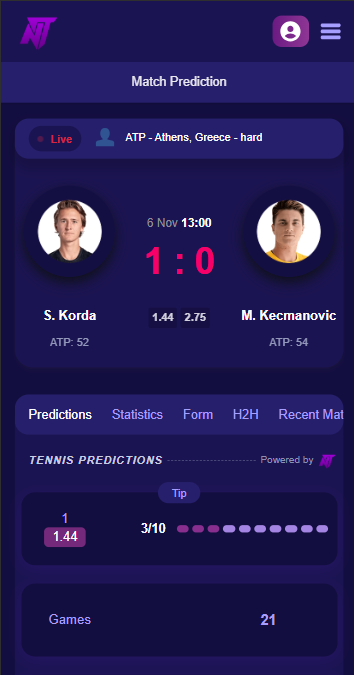
Smarter every day: Our system learns from new matches daily, continuously improving its analysis across ATP and WTA events.
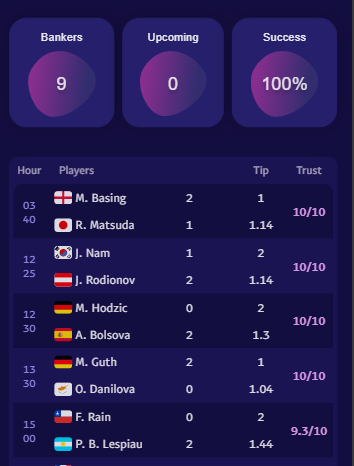
Created for real performance: Every forecast is the result of detailed analysis, producing the best tennis predictions based on player form, surface type, and match context.
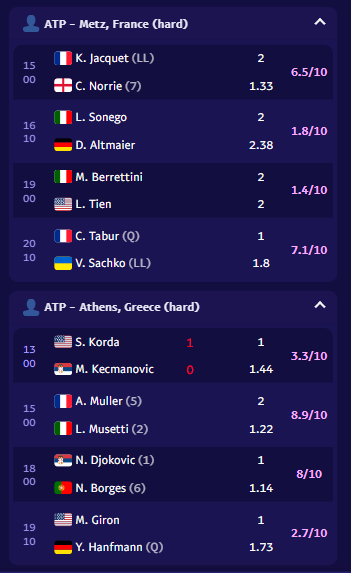
Powered by Artificial Intelligence, mathematical modeling, and machine learning, our Java-based engine delivers tennis tips with precision and consistency.
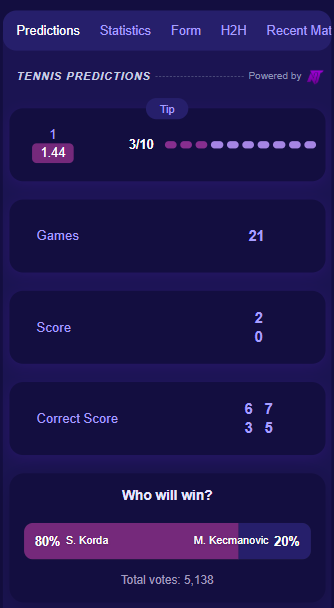
AI that never rests: When hundreds of matches are on the schedule, our model highlights the most trusted picks — where manual analysis can’t keep up.

We believe in full transparency. Follow our progress to see how data and AI-powered insights come together to redefine modern tennis analysis.
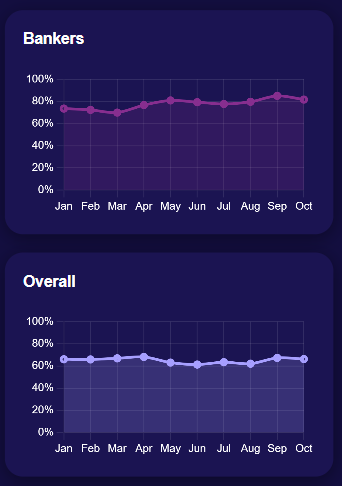
Smarter Tennis Tips
Our AI engine breaks down every point and pattern across ATP and WTA tournaments, turning complex stats into clear match insights you can rely on.

Let data and AI guide your match choices — forecasts designed to improve your long-term consistency.
From Grand Slams to local qualifiers, our platform delivers tennis analysis for every match.
THE SCIENCE OF PREDICTION

Our Java-based engine continuously gathers verified tennis data from licensed ATP and WTA sources through secure APIs. This includes detailed match statistics such as serve accuracy, break points, aces, player fatigue, surface type, and real-time performance metrics.
Every piece of information is stored within our scalable data platform — designed specifically for high-frequency tennis analysis. From live scores to historical results, player rankings, and schedule updates, the system ensures nothing is missed when building accurate tournament insights.

Raw tennis data is rarely perfect. Before any forecast is made, our system normalizes and validates thousands of data points to eliminate inconsistencies. Each record is cleaned, standardized, and aligned to a unified structure that our learning models can interpret effectively.
This stage is crucial — it ensures that the algorithm’s conclusions are drawn from structured, trustworthy information. By filtering out anomalies and bias, we maintain analytical integrity across all match projections.
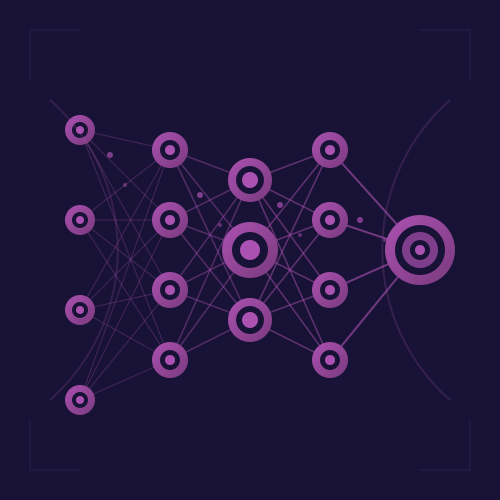
Once the raw data is processed, our proprietary prediction engine—built on advanced deep neural networks and adaptive pattern recognition—takes over. It evaluates a broad range of contextual variables, including player momentum, recent performance trends, historical matchups, serve-return efficiency, surface adaptability, and psychological resilience under tournament pressure. By integrating these multidimensional factors, the model generates forecasts with exceptional precision and repeatable consistency.
What Our Users Say